Hardwood Floor Drying in Woodstock, GA
The oak in the kitchen has a ridge along every board where the dishwasher sits, and the edges catch your sock when you walk across it in the morning. This site connects you by phone with an independent local provider who does hardwood floor drying in Woodstock and across Cherokee County.
Reading the boards from the top and from the crawl space
Cupping means the bottom of each board is wetter than the top, so the crew meters both sides. Upstairs they take readings across the wet zone and out past it until the numbers match a dry part of the floor. Then they go under the house, if there is a crawl space, and meter the subfloor from below, because a floor that cupped from a wet crawl space has a different fix from one that cupped from a dishwasher.
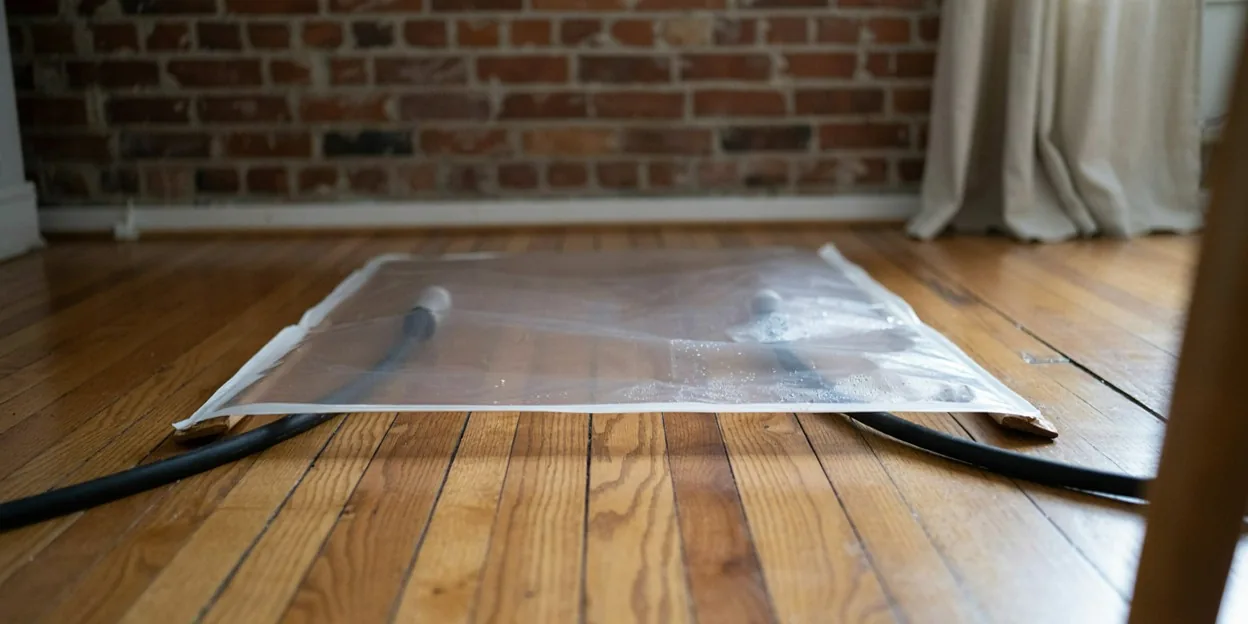
If the boards can be saved, the crew lays drying mats over the wet zone. The mats pull air through the seams and out of the boards and the subfloor, with a dehumidifier running in the room. Readings get taken daily, and the mats stay until the top and bottom of the boards match.
Stop the leak, dry the surface, and do not sand anything yet
Find the source and stop it: the dishwasher supply, the ice maker line, the sink trap, or the crawl space below. Wipe up surface water and get rugs off the floor so the boards can breathe. Keep the room closed and the air conditioning on; it removes moisture, while an open window in a Georgia summer adds it.
Do not sand, refinish, or pull boards. A cupped floor often flattens as it dries, and sanding it flat while it is wet leaves a crowned floor when it finishes drying. Photograph the boards at a low angle so the cupping shows, then call.
Boards that flatten, boards that come up, and how the readings decide
Solid hardwood that cupped from a short leak usually flattens once the readings even out, though it can take a couple of weeks under mats. Boards that buckled off the subfloor, split at the tongue, or turned black at the seams generally come up. Engineered flooring with a thin veneer rarely recovers once it delaminates. Finish that clouded can be redone after the floor is dry; refinishing waits until the boards have stopped moving.
The subfloor under the boards is part of the job. If it stayed wet, the room needs structural drying as well as the mats, and if the water pooled under the house first, crawl space water extraction comes before anything else.
Hardwood over crawl spaces from Eagle Watch to Ball Ground
The late-1980s and 1990s houses in Towne Lake, Eagle Watch, and Deer Run were built with hardwood in the foyer and kitchen over a plywood subfloor, and the newer builds in Brookshire, BridgeMill, and the farmhouse-style subdivisions toward Ball Ground put it through the whole main level. A large share of those floors sit over a vented crawl space rather than a basement, and that space runs humid all summer.
That is why hardwood in this county cups from below as often as from above. A wet crawl space after the September 2009 rains, or after any week of summer storms that leaves water on the clay under the house, raises the moisture in the subfloor, and the boards above lift at the edges without a drop ever hitting the top. The other common source is the kitchen itself: a dishwasher on its fifteenth year, a refrigerator line, or a sink supply that has been dripping into the cabinet base. A slow leak under a cabinet runs across the subfloor for weeks before the boards outside the cabinet cup. Ask the crew to meter the toe kicks and the crawl space, not just the visible boards.
Calling about a floor that is cupping or lifting
Say which room, what is near the wet boards, whether there is a crawl space or a basement under the floor, and how long the cupping has been visible. Mention whether the leak has been stopped. Have the neighborhood name and a callback number ready. Call (770) 697-0510.